
Our News….
Understanding Lasting Powers of Attorney: Securing Your Future Decisions
Life is unpredictable. A sudden illness or accident could leave you unable to make decisions for yourself, placing a significant burden on your loved ones. As we age, concerns about our capacity in the future become even more pressing. What happens if you can’t make decisions for yourself?

One of the most effective ways to ensure your wishes are respected is by setting up a Lasting Power of Attorney (LPA). At Christchurch Solicitors, we specialise in guiding individuals and families through the LPA process, ensuring that you have the right legal protections in place for your future.
What is a Lasting Power of Attorney?
A Lasting Power of Attorney (LPA) is a legal document that allows you to appoint a trusted person (your attorney) to make decisions on your behalf if you become unwilling or unable to do so. Unlike a will, which only takes effect after death, an LPA is used during your lifetime to safeguard your rights and preferences.
By planning ahead, you can set out clear instructions for your loved ones, ensuring that your financial affairs, medical care, and daily living decisions are handled in a way that reflects your wishes.
Types of Lasting Powers of Attorney
There are two types of Lasting Powers of Attorney, each serving a different purpose:
Health and Welfare LPA
This LPA covers decisions about your health and personal welfare, including:
– Medical treatment and consent to procedures
– Day-to-day care (e.g., where you live, what you eat)
– Choosing a care home and dealing with Care Providers and Social Services
– End-of-life care decisions
The Attorneys appointed under a Health and Welfare LPA can only make decisions for you once you have become unable to make these decisions yourself.
Property and Financial Affairs LPA
This LPA allows your attorney to manage your finances and property, including:
– Accessing bank accounts and managing bills
– Handling pensions and benefits
– Selling your house or managing investments
– Dealing with financial institutions on your behalf
You can choose to have one or both types of LPA and appoint the same or different attorneys for each.
The Risks of Not Having an LPA
Without an LPA in place, your loved ones may face significant challenges in supporting you if you become incapacitated. You risk losing control over who makes important decisions on your behalf, leaving these choices in the hands of the courts instead.
Financial difficulties can arise as family members may struggle to access funds or manage essential payments, while critical healthcare decisions could be made without full consideration of your wishes.
The emotional and legal burden on loved ones can be overwhelming, as they may face complex processes to assist you. Without an LPA, they must apply for a Deputyship Order through the Court of Protection – a potentially time-consuming, costly and complicated alternative that can cause unnecessary stress and delays.
The Benefits of Having an LPA
Having an LPA provides peace of mind, ensuring that your wishes are respected if you ever become unable to express them. It allows you to stay in control, deciding in advance who will make important decisions on your behalf and how those decisions should be handled.
An LPA also protects your loved ones by preventing unnecessary stress and legal complications, sparing them from the difficulties of navigating complex court processes. Unlike Deputyships, which can take months to arrange, an LPA offers faster access to support, taking effect as soon as it is registered with the Court, so critical decisions can be made without delay.
When Should You Set Up an LPA?
Many people assume that LPAs are only for the elderly, but accidents and illnesses can happen at any age. Setting up an LPA before it’s needed ensures you have the legal safeguards in place while you still have full mental capacity, which you must have to create the LPA.
Anyone over the age of 18 can benefit from an LPA, whether you’re planning for later life or simply want to be prepared for the unexpected.
Tips for Creating a Successful LPA
Who to choose as your Attorneys – Appoint people you trust, considering whether they will act together or separately.
Completing the Forms Accurately – Errors can lead to delays, rejection and unnecessary additional fees
Signing & Witnessing Correctly – Ensure the legal formalities are met as without this the LPA can be rejected
Registering with the Office of the Public Guardian – An LPA must be registered before it can be used by the Attorneys
Take the First Step Towards Securing Your Future
At Christchurch Solicitors, we can provide expert guidance on creating and registering Lasting Powers of Attorney, ensuring your LPA is legally sound, tailored to your individual needs, and providing the protection you deserve.
Deeds of Variation: A Second Chance to Put Things Right

When someone dies, their Will (or the intestacy rules) determines how their estate is distributed. However, families sometimes find that the Will no longer reflects the most tax-efficient or practical outcome. This is where a Deed of Variation can be invaluable. A Deed of Variation allows beneficiaries to redirect all or part of their inheritance to someone else after death. It does not rewrite the Will, but it alters how the estate is treated for inheritance tax and capital gains tax purposes - provided it is completed correctly and within the required timeframe.
There are many reasons why a Deed of Variation might be appropriate. It can be used to reduce an inheritance tax liability, pass assets into a discretionary trust, provide for children or grandchildren, or correct an unintended imbalance between beneficiaries. It can also be a practical solution where family circumstances have changed - for example, where a beneficiary is financially secure and would prefer to redirect their entitlement to the next generation. Importantly, to be effective for tax purposes, the variation must usually be made within two years of the date of death, and it must meet strict statutory requirements. Once that window closes, the tax advantages are generally lost.
A Deed of Variation is a powerful planning tool, but it must be handled with care. All affected beneficiaries must agree, and the drafting must be precise to ensure HMRC recognises the variation for tax purposes. At Christchurch Solicitors LLP, we can advise swiftly on whether a variation is appropriate and prepare the necessary documentation. Given the two-year time limit, early advice is crucial. If you believe a Deed of Variation may be relevant to your family's circumstances, we recommend seeking advice as soon as possible to protect both flexibility and potential tax savings.
Second Marriages, First Families: Protecting the People You Love Most

Blended families are now a familiar part of modern life. Many couples marry later, bringing children from previous relationships into a new partnership. While emotionally rewarding, second marriages can create complex legal and financial considerations - particularly when it comes to Wills. It is not uncommon for a property to remain in the sole name of one spouse, especially if it was owned before the marriage. Without careful planning, this can leave the surviving spouse exposed. If the Will leaves the property outright to children from a first marriage, the surviving husband or wife may have no automatic right to remain in the home they have been living in.
This is where thoughtful estate planning becomes critical. A well-drafted Will can incorporate a life interest trust or a right to occupy, allowing the surviving spouse to remain in the property for their lifetime (or for a defined period) while preserving the underlying capital for the children. This structure balances competing interests: it protects the surviving partner's security and stability, while safeguarding the inheritance intended for the next generation. Without such provisions, families can face uncertainty, tension and, in the worst cases, a forced sale of the home at a time of grief.
At Christchurch Solicitors LLP, we understand the sensitivities involved in second marriages and blended families. These conversations are not always easy, but they are essential. Careful drafting now can prevent significant hardship later. Ensuring that a surviving spouse has a secure roof over their head - without unintentionally disinheriting children - requires experience, clarity and foresight. Taking advice at the right time can make all the difference between conflict and confidence for those you leave behind
Life Interest Trust or Right to Occupy? Understanding the Difference - and the Tax Consequences

Plan for your future today - Couple in a solicitors office
When preparing a Will, particularly in the context of second marriages or blended families, two frequently considered options are a life interest trust and a right to occupy. While they can appear similar in practical effect - often allowing a surviving spouse or partner to remain living in a property - they are not identical in legal structure or tax treatment. The distinction lies not in the label used, but in how the provision is drafted.
A life interest trust (commonly an Immediate Post-Death Interest) gives a named beneficiary a formal legal entitlement to benefit from trust assets during their lifetime. This typically includes the right to occupy a property and, where applicable, to receive income from other trust assets. The capital is preserved for ultimate beneficiaries, such as children, after the life tenant's death. A right to occupy, by contrast, is often narrower in scope. In most professionally drafted Wills, a right to occupy is implemented through trustees holding the property for the ultimate beneficiaries, subject to the surviving spouse's right to reside there. In those circumstances, it will usually constitute an interest in possession, and therefore operate as a form of trust. However, if drafted more loosely - for example, as a personal permission or without clear trust provisions - the legal and tax consequences may differ. The outcome depends entirely on the drafting.
From a tax perspective, this is significant. A properly structured life interest trust for a surviving spouse will normally qualify for the spouse exemption for Inheritance Tax on first death, meaning no IHT is payable at that stage. The trust assets are then treated as part of the surviving spouse's estate for IHT purposes on their death. A right to occupy can achieve the same result if it amounts to a qualifying interest in possession. However, if it does not meet those requirements, it may fall within the relevant property regime, potentially exposing the trust to periodic or exit charges. Capital Gains Tax treatment can also vary depending on how the arrangement is structured and whether principal private residence relief applies.
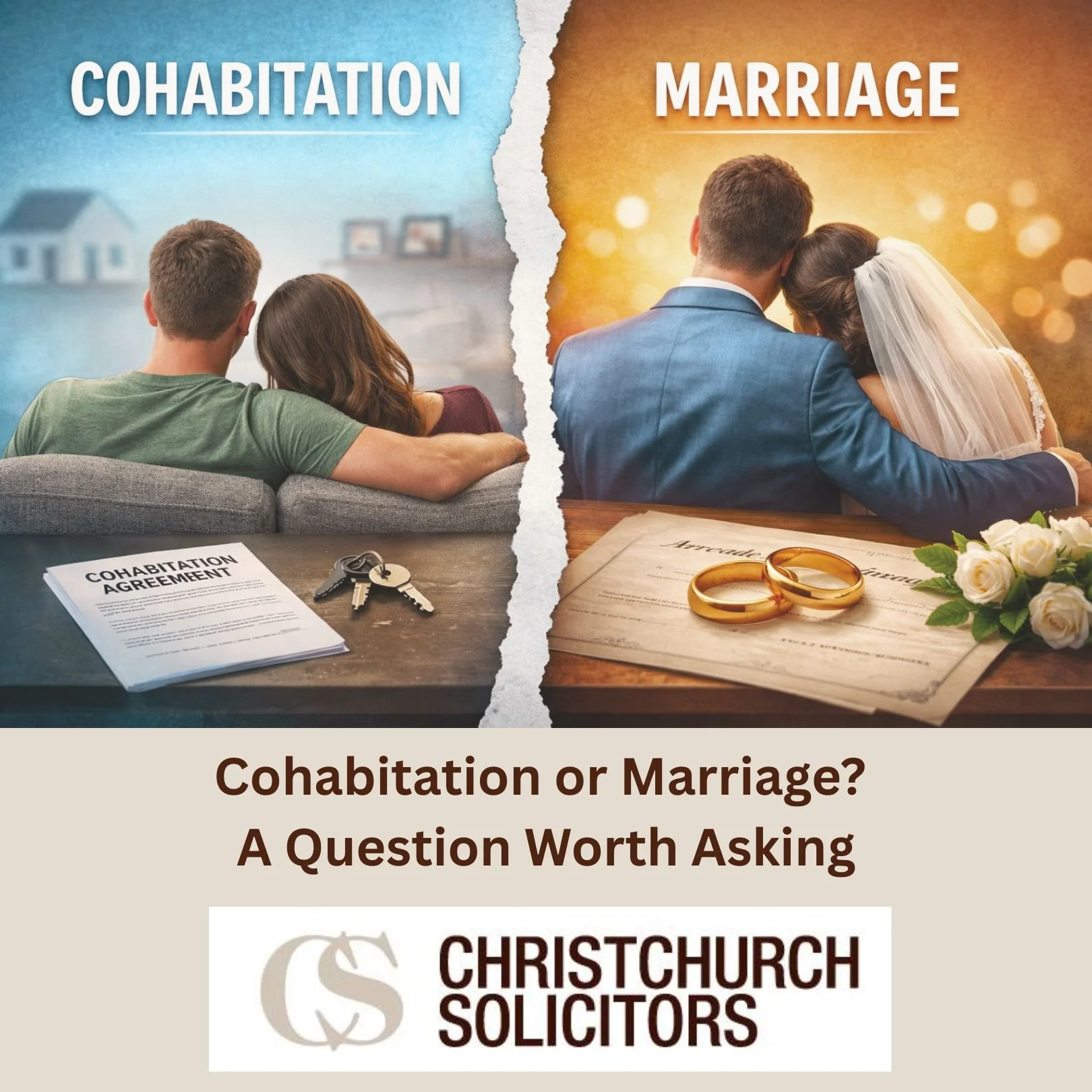
Cohabitation or Marriage? A question worth asking.
Cohabitation or Marriage? A Question Worth Asking
At Christchurch Solicitors LLP, we ensure that clients understand not just the terminology, but the legal and tax consequences of each option at the drafting stage. What may appear to be a subtle difference in wording can materially affect the protection afforded to a surviving spouse and the tax efficiency of the estate. Careful, specialist drafting ensures that both family security and fiscal prudence are properly balanced.
Cohabitation or Marriage? A Question Worth AskingAt Christchurch Solicitors LLP, we are often asked whether marriage really makes a financial difference in modern life. For many long-term couples who live together, share property and raise children, the relationship feels no different from marriage. However, in law, the distinction can be significant. Married couples and civil partners benefit from valuable tax exemptions that unmarried couples simply do not. For example, transfers of assets between spouses or civil partners are generally free from capital gains tax, and on death there is an unlimited inheritance tax spouse exemption. By contrast, long-term cohabitants are treated as separate individuals for tax purposes, potentially exposing estates to substantial inheritance tax liabilities.
The inheritance tax position alone can mean the difference between preserving family wealth and losing a significant proportion to HMRC. Assets passing between spouses or civil partners on death are exempt from inheritance tax, and any unused nil-rate band can be transferred, potentially doubling the available allowance. Unmarried partners do not benefit from this protection, regardless of how long they have lived together. In practical terms, a modest civil ceremony at the register office can safeguard assets worth hundreds of thousands of pounds. It is no coincidence that shortly before his death, comedian Ken Dodd married his long-term partner, a decision widely understood to have secured substantial tax advantages for his estate.
Marriage or civil partnership is, of course, a personal decision. But from a legal and tax planning perspective, it is one that deserves careful consideration. A simple, low-key ceremony can provide powerful financial protection, particularly for couples who own property together or have accumulated significant assets. We encourage anyone in a long-term relationship to take advice and understand the implications — not only emotionally, but legally and financially — before assuming that cohabitation offers the same security as marriage.
Family Mediation Voucher Scheme EXTENDED

Couple in mediation
A little-known government scheme giving separating couples a payment of up to £500 in funding to help during the separation process has been extended by the UK Government until March 2026.
The scheme could see more couples involved in mediation and avoiding lengthy court proceedings. Our Family Law team can give you further information on using the service, alongside solicitor-aided representation.
Under the scheme, which will now run until March 2026, families can claim help towards mediation services, which can assist in sorting out financial and custody arrangements. A trained mediator oversees the process and works with the separating couple to find the best solution.
This initiative aims to reduce court backlogs and help couples resolve financial or custody arrangements amicably.
https://www.gov.uk/guidance/family-mediation-voucher-scheme
divorce solicitors in suffolk …
If you separate from your spouse you should immediately make a Will. The consequence of not doing so is that if you then, heaven forbid, die unexpectedly your ex-spouse will benefit entirely from your estate.

SEPARATING?
Then read on …
However, if you separate then go on to divorce without making a will, your estate would go to your next of kin (this could be your children, parents or siblings) under intestacy laws.
Imagine this scenario; Charlotte marries Michael. She has three children from a previous marriage. After two years Charlotte and Michael separate but don’t divorce. Charlotte then dies unexpectedly. Charlotte had made a Will four years before she’d even met Michael. All Wills are revoked on marriage so that applies here. Charlotte’s children receive a share of the estate only because she dies intestate and leaves a surviving spouse - her husband - even though they are separated and had only been married for two years. Charlotte did not intend for this to happen.
Sounds unfair?
If you’re thinking of separating and would like to look out for your loved ones, do get in touch with us now for a confidential no-obligation chat with a qualified solicitor.
Call us on 01473 355160 or email us at: info@christchurchlaw.co.uk
WE CAN HELP

NOW is the time to put some certainty into your affairs and think about making your will so your loved ones are protected and cared for in the future.
Our offices, opposite Christchurch Mansion in Ipswich, are currently open and our team can offer a very prompt service, either through phone calls, Skype, Zoom or email - you could have a finished will within a matter of days. Please call our helpful team now on 01473 355160

married abroad?
Did you get married in a foreign country? Do you or your partner have connections abroad? Whoever starts the divorce proceedings might be able to decide which country those proceedings will play out in? This could have a HUGE impact on the outcome of a divorce.
* Please call our expert team at Christchurch Solicitors LLP to help you navigate this on 01473 355160. Skype and phone appointments available.
Changes in organ donor law - how will it affect you?

Did you know that a new organ donation law has come into effect this month (as from Wednesday May 20th) in England? It means the majority of adults are now automatically considered to be organ donors. This follows change in legislation brought about after campaigning by a young boy who received a new heart from a nine-year-old girl who died after a car crash. Also known as Max and Keira's Law, it means those aged 18 and over are now deemed to have automatically given consent to donate their organs when they die, unless they explicitly state otherwise or are in an excluded group.
It is hoped that this will lead to an additional 700 transplants each year by 2023.
If you have any concerns or questions about this, this is a matter which Christchurch Solicitors consider when advising our older clients, and it is our practice to prepare an Advance Decision (setting out one's medical treatment preferences) for the client to sign. We then send this to your GP asking for the information to be placed within your medical records.
* If you need to update your Will, following a change in any circumstance, call us now and we can help guide you through the legal landscape so you can make an informed choice. Call our friendly team on 01473 355160.